By Jo Garner, CEO and Founder, Strategic Grants
Across corporate, community and family philanthropy, funding models differ—but the direction of travel is clear: stronger relationships, greater trust, deeper community voice and a sharper focus on long-term impact.
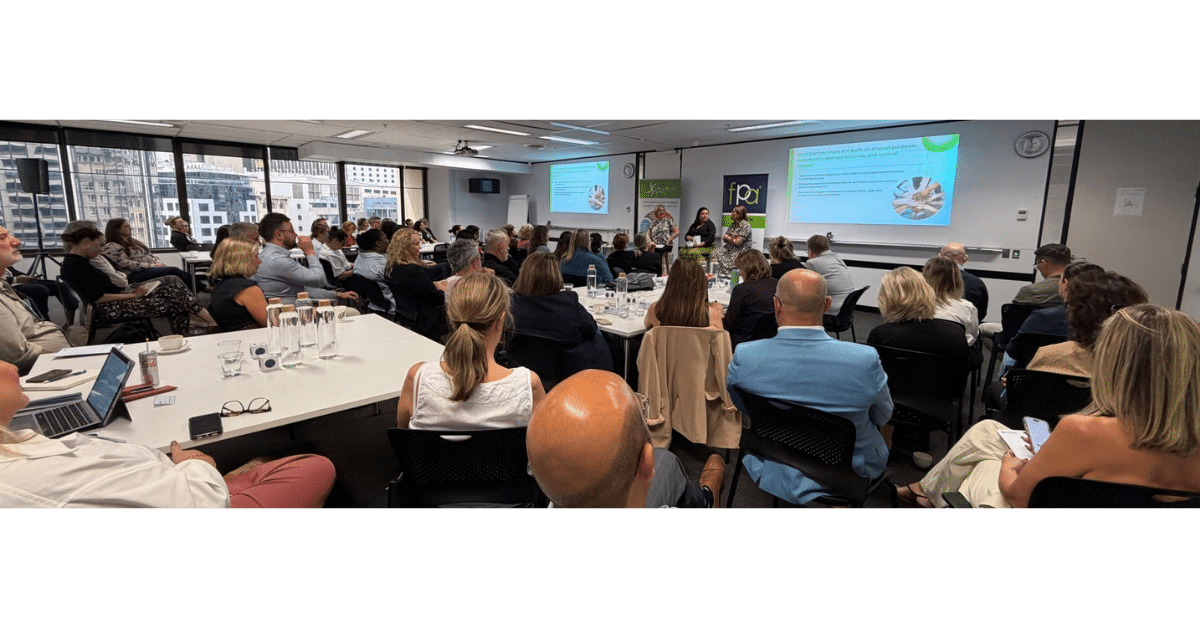
At the recent For Purpose Alliance October Keynote Series, I facilitated a discussion on the future of funding with Rachel Kerry, CEO of CAGES Foundation, and Loredana Fyffe, CEO of Sydney Community Foundation, including the Sydney Women’s Fund. Anna Le Masurier, Regional Head, Australia and New Zealand, Macquarie Group Foundation, was unfortunately unable to attend due to illness. However, we shared relevant perspectives from Macquarie Group Foundation so the discussion could still reflect three distinct approaches: family, community and corporate philanthropy.
The differences between these funder types matter. Each has its own stakeholders, decision-making structures, funding constraints and ways of building partnerships. Yet the strongest message from the discussion was common to all: funders are increasingly looking beyond well-packaged projects as their number one criteria. Instead, they are increasingly focusing on the strength of the organisation in its accountability to community, capacity to learn and readiness to build a transparent, long-term partnership.
Different funder types, different pathways
Corporate foundations: alignment, scale and engaged philanthropy
Alongside their grant making capacity, corporate foundations can also draw on the people, skills and networks of their business. The Macquarie Group Foundation’s model is based on the principle that matching employee giving and fundraising, facilitating opportunities for skilled and unskilled staff volunteering, and rewarding non-profit board participation is of considerable additional benefit to its grant partners and beyond.
The first expression-of-interest process for its strategic grant making budget in 2025 attracted more than 150 applications and, through a shortlisting process designed to minimise bias and prioritise lived experience, resulted in six multi-year partnerships worth between $200,000–$500,000 per year. Excitingly for organisations seeking funding, half of the successful organisations were new partners. This demonstrated the value of an open process when the available funding pool is sufficiently large: the process can validate existing beneficiaries based on their clear adherence to the grant making strategy while surfacing organisations a funder may not otherwise encounter.
For charities, the takeaway is to make the alignment with the corporate funder’s criteria as clear as possible. Be precise about your mission, geography, community, approach and intended outcomes.
Additionally, don’t forget to explain the evidence behind your work, the distinctive role you play in a collaborative ecosystem and the impact a larger or longer-term investment might make possible. Corporate funders may have formal processes, but the best partnerships still depend on relationships that feel collaborative, responsive and grounded in trust.
Community foundations: place, participation and local relationships
Community foundations begin with the place or community they exist to serve—for example, Greater Sydney, or the LGBTQIA+ community across Australia. Their role is threefold: to understand local need; to listen, convene and advocate; and, alongside communities, to translate and amplify those needs to donors and decision-makers. At Sydney Community Foundation, this work is grounded in opportunity and equity for women and families, belonging and wellbeing, education and employment, and place-based community transformation.
Some community foundations hold significant endowments, while others raise funds from donors who care deeply about local needs, lived experience and shifting power towards communities that know what they need. This means funding does not always rely on traditional open grant rounds. It can be more collaborative, creating genuine partnerships with organisations to help secure philanthropic capital.
The model also enables participatory grant-making and community-led decision-making. In Mount Druitt, for example, a partnership between Sydney Community Foundation, the Paul Ramsay Foundation and The Australian Centre for Social Innovation is enabling community members to help guide the distribution of a $4.1 million grant pool over four years. For these funders, the strongest readiness signal is not corporate polish but credibility in community. Charities need to demonstrate who has shaped the work, how lived experience informs decisions, and why their response reflects genuine community need.
Relationships should therefore be built before a proposal is presented, through consistent participation in sector and community conversations.
Family foundations: trust, self-determination and patient partnership
Family foundations can have greater discretion than some other funders in taking a long-term, relational approach. CAGES Foundation partners with Aboriginal-controlled and Aboriginal-led organisations through a model centred on self-determination, cultural accountability and untied funding. Partnerships begin with relationships and conversation rather than a conventional application, and five years is treated as a starting point; some partnerships have continued for 15 years.
Due diligence is focused on who governs the organisation, who participates and how the organisation is accountable to community. Success is not imposed by the funder: instead, communities define what progress looks like and how it should be understood. Untied funding is seen as very important, but it does not remove accountability—rather, it locates accountability where it belongs.
For charities, this means entering the relationship as a partner rather than a supplier. You need to know the expertise, authority and community legitimacy you bring.
Be prepared to challenge assumptions respectfully, protect cultural and community boundaries, and propose a more workable approach where a funder’s model does not reflect reality.
The trends reshaping funding
Across all three models, several trends are converging.
- Relationships are moving ahead of transactions. Funders want deeper understanding, honest conversations and partnerships that can evolve—not simply a strong application followed by compliance reporting.
- Multi-year and flexible funding are gaining ground. There is growing recognition that one-off, tightly restricted grants can undermine sustained impact. Untied funding remains the gold standard for many, but meaningful flexibility and realistic program funding also matter.
- Community voice is becoming central. Participatory and place-based grant making, self-determination and accountability to community are reshaping how decisions are made and how success is defined.
- Learning is replacing the performance of certainty. Strong funders do not expect every plan to remain fixed. They want partners who can explain what is changing, why a pivot is needed and what has been learnt.
- Organisational strength matters as much as project design. Funders increasingly want to understand governance, leadership, systems, culture, financial resilience and the organisation’s capacity to create long-term change.
- Funding is only one lever. Convening, introductions, advocacy, staff expertise, pro bono support and impact investing may all form part of the partnership—provided they are useful and do not create additional burden.
What it means to be funder ready
Funder readiness is the ability to show that your organisation knows its purpose, understands its community and can use funding responsibly to create meaningful change. And then being able to present that information in a succinct manner either directly, or through an application or proposal.
- Build a culture of philanthropy from the top. Funding cannot sit solely with the fundraising team. The board, CEO, leadership team and program staff all have a role in articulating the need, building relationships and stewarding partnerships.
- Know your non-negotiables. Be clear about the community voice, cultural integrity, quality standards, legal obligations and true delivery costs that must be protected.
- Research genuine alignment. Understand the funder’s purpose, priorities, geography, preferred approach and appetite for risk. Do not apply simply because a grant is available.
- Make the core idea easy to find. Answer the question asked. Explain the need, your response, your evidence, your distinctive role and what the investment will enable.
- Present realistic funding scenarios. Know the baseline cost of quality delivery and be ready to discuss different funding levels, durations and restrictions—including their consequences.
- Demonstrate governance and adaptability. Funders need confidence in leadership, decision-making, financial management and the organisation’s capacity to respond when the context changes.
- Invest in relationships before applications. Be visible, contribute to sector conversations, listen well and help funders understand the wider issue—not only your organisation.
- Treat reporting as learning. Speak early when something is not working. A well-evidenced pivot can demonstrate sound judgement, not failure.
Preparing for the future of funding
The future is likely to bring more participatory grant making, more place-based approaches, greater next-generation donor engagement and more hybrid models that combine grants with impact investing. It will ideally also bring more patient capital, more flexible funding and greater willingness to support important work that is not easy to package or brand.
But charities should not wait for funders to drive every change. Organisations need to communicate how they are strengthening their own systems, building community-led change and creating the conditions for long-term impact. They should enter funding conversations with confidence in their expertise and evidence—not with the assumption that the funder has all the answers.
As the sector continues to evolve, your strongest position is not, “We can perform for a funder.” It is, “We know our purpose, our people and the change we are here to make.”
Different funders will continue to use different models. The organisations best placed to succeed will be those that understand those differences while preparing for what all good funding partnerships increasingly require: alignment, trust, community legitimacy, honest learning and the courage to have real conversations.
This blog article is a summary of a presentation delivered as a keynote presentation for the For Purpose Alliance, for Sydney Hub members and guests. Strategic Grants is proud to partner with the For Purpose Alliance to support leadership development and capacity building across the sector. For Purpose Alliance Hubs operate in Sydney and Brisbane, to empower social enterprise, charity, and nonprofit leaders through coaching, peer support, and leadership programs rooted in collaboration, equity, and impact. For more information visit the For Purpose Alliance website: https://forpurposealliance.com.au/
About the author

Jo Garner is the CEO & Founder of Strategic Grants. Jo established Strategic Grants in 2009 and in 2012 she launched what is now GEMS – Grants Expertise Management System – New Zealand and Australia’s largest online grant-seeking management system. Jo leads a passionate team of 35, who are all dedicated to working collaboratively with for-purpose organisations to build their capacity and secure grant funding to deliver vital projects to achieve their mission.
With a background in Business, Marketing, IT and Fundraising, Jo’s strong communication skills and ability to apply strategic thinking and solutions to challenges faced by NFPs, has seen Strategic Grants help hundreds of organisations raise funds to deliver their mission through effective funding and engagement strategies.
Jo is a regular presenter at philanthropy and fundraising conferences and is known for her engaging training techniques and facilitation of strategic planning workshops.