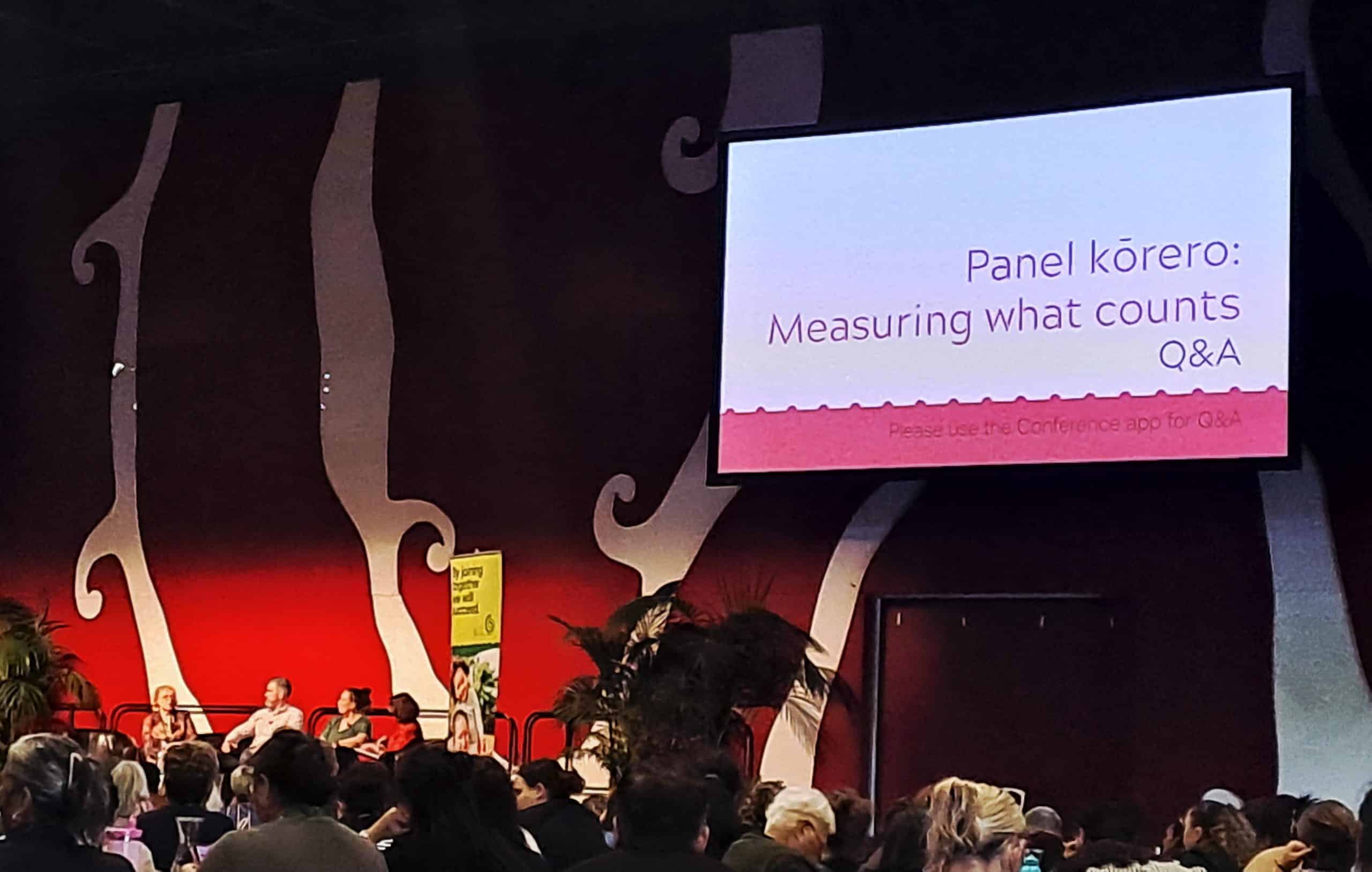
In September 2025, our Strategic Grants Aotearoa team joined over 400 kaimahi in Rotorua for the sold-out Whakamanawa: Empowering our Communities conference, hosted by Social Service Providers Aotearoa (SSPA).
Across two days of workshops and kōrero, one theme came through loud and clear: organisations know the value of their mahi, but many struggle to prove it.
While social service providers deeply understand the difference they make in their communities, they often lack the systems and tools to capture that impact in a way that funders and stakeholders can see and trust.
The shift to outcomes-based contracting
Many organisations shared stories of long-standing government contracts being cut or partially funded. Even those not yet directly impacted expressed concern about the uncertainty and unsustainability of relying solely on central government support. Diversification of income has never been more important to embed into organisational strategy.
Layered on top of this landscape of government cuts, a major shift discussed during the panel ‘Measuring What Counts’ was the move from outputs-based to outcomes-based contracting, led by the new Social Investment Agency. While this approach is familiar in the philanthropic space, it is now expected to expand across government contracts.
Why measurement matters
Many organisations have a deep understanding of the impact of their mahi, yet often lack the systems and tools needed to collect qualitative and quantitative data that brings their impact story to life. With growing demand for outcomes-based reporting, many organisations are exploring tools and frameworks that capture both qualitative and quantitative evidence. Building internal capability in this area will help them tell compelling impact stories over time.
Tools to help
We loved seeing practical tools and examples shared at the conference.
A free tool from Powerdigm (Inspring Communities) designed to help organisations measure and share their impact. The team also hosted a demo webinar – the recording can be found on YouTube here.
Research and Evaluation
Presbyterian Support Northern shared two practical examples of in-house evaluation and impact reporting.
- KIDshine Outcome Evaluation Report – the team conducted qualitative research with participants, applying best-practice evaluation measures to work with a vulnerable population of children. This included transparency with participants, tailoring the approach to data collection depending on the whānau and effective collaboration between the evaluation team and the kaimahi on the ground. Read the report here.
- Social Workers in Schools (SWiS) Social Return on Investment (SROI) Report – Using internal resources, the evaluation team calculated a research-informed SROI. Read the summary report here.
These examples show that with the right tools, resources and capability, organisations can tailor their outcomes-reporting approach to suit the communities they serve.
Knowing your impact is powerful, but being able to prove it is key to demonstrating your organisation’s success in driving change and achieving their mission.
As the stormy and turbulent funding landscape continues to change across the social sector, maximising tools and resources available to boost capacity in funder engagement and impact reporting is increasingly important.
If you would like to explore how we can support your organisation, with training, access to a grants database customised specifically to you, and other supports, just drop us a line: [email protected]
Strategic Grants is here to help you every step of the way.